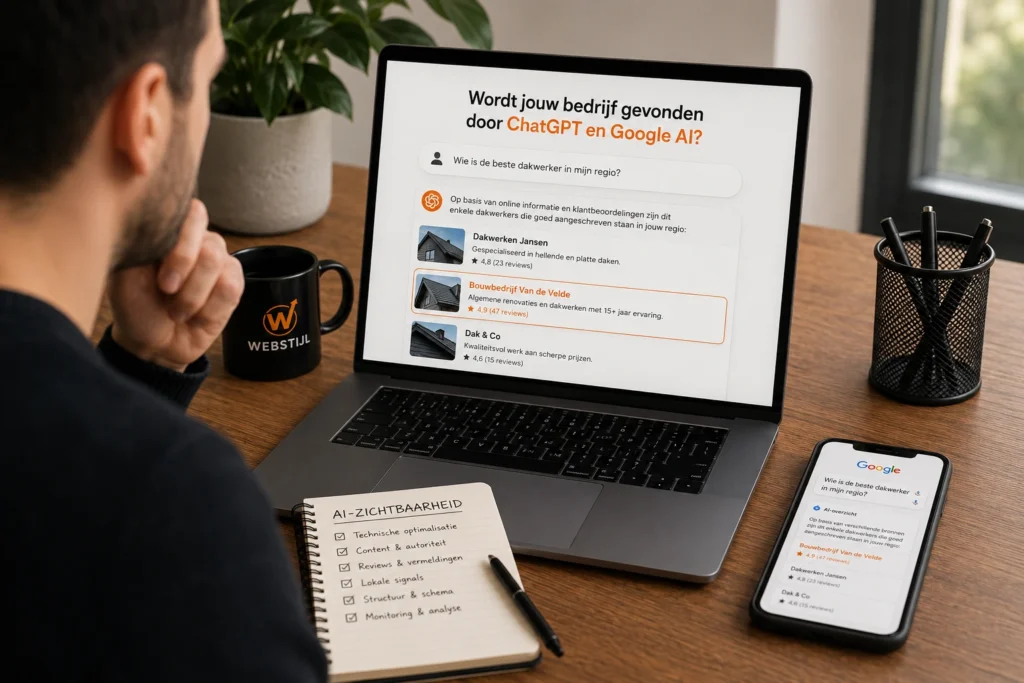
Yes, your business can also be found by AI search engines such as ChatGPT, Google AI Overviews, and Perplexity. They draw their answers from public information on the web: the more clearly your website answers specific questions and the more often your company is mentioned online, the more likely AI is to suggest you as an answer to potential customers.
Your customers search differently than they used to
Imagine: someone in your area has a leaky roof. In the past, that person would type “roofer + city” into Google and click on a few results. Today, a growing number of people are asking ChatGPT that question directly: “Who is a reliable roofer near Leuven, and what should I look for?” The answer they get isn’t a list of ten links—it’s a single detailed recommendation, including a handful of company names.
Even people who are just doing a Google search are increasingly seeing an AI-generated response first. Google displays a AI Overview: a concise answer to the question, with links to a limited number of sources. If you’re not listed there, many visitors will never scroll down to your website.
For you as a business owner, this has important implications: being found is no longer just about your ranking in traditional search results. It’s increasingly about whether AI systems recognize your business, understand what you do, and trust you as a source.
How do AI search engines come up with their answers?
To understand how you fit into this, it helps to know where those answers come from. AI search engines generally combine two sources of knowledge.
What the system already “knows”
AI models such as ChatGPT are trained on enormous amounts of text from the public web. As a result, companies that have been mentioned regularly in recent years—in articles, reviews, business directories, and news reports—are literally stored in the model’s memory. A company that leaves hardly any trace online simply does not exist for such a model.
What the system looks up in real time
In addition, modern AI tools search the web in real time for many questions. ChatGPT, Perplexity, and Google AI Overviews retrieve up-to-date web pages, read them, and use that information to construct their answers—often including a source citation. The same rules apply here as they do for a human reader who scans quickly: if the answer is clear and directly on your page, you’ll easily be used as a source. If the answer has to be pieced together from five vague paragraphs, the AI will choose a competitor who does explain it clearly.
Why This Works Differently from Traditional SEO
Traditional SEO is all about ranking: appearing as high as possible in a list of links so that people click on you. AI search is about something else: be mentioned and quoted in a response formulated by the AI itself. That difference has practical implications.
In a traditional search, the fourth spot is still valuable. An AI-generated result often mentions only two or three companies or sources—you’re either in it, or you don’t exist. What’s more, AI looks beyond just your website: Google reviews, mentions on other sites, and the consistency of your company information across the web all factor into the system’s perception of you.
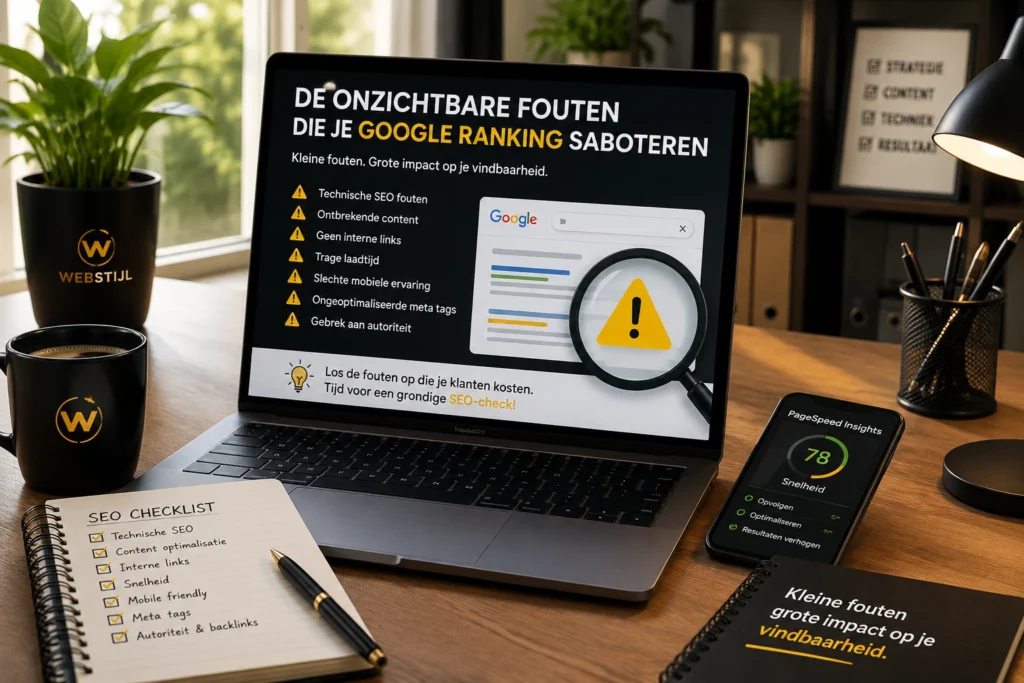
Betekent dit dat klassieke SEO afgeschreven is? Nee, integendeel. AI-systemen halen hun live informatie grotendeels uit dezelfde zoekindex als Google. Een website die technisch niet in orde is — traag, slecht gestructureerd, onvolledig geïndexeerd — raakt ook niet in AI-antwoorden. De technische basis blijft dus de fundering; welke fouten daar het vaakst mislopen, lees je in ons artikel over de onzichtbare fouten die je Google-ranking saboteren. Dit artikel gaat over de verdieping die daar bovenop komt.
Here's how to increase the chances that AI will mention your company
Good news: you have more control over this than you think. The approach differs from traditional keyword optimization, but it’s perfectly achievable for a business owner.
Answer questions immediately and at the top of the page
AI systems look for the shortest path to a useful answer. Therefore, for every article and service page, put the specific answer to the key question right at the top—in two or three sentences—before you go into detail. If you’re writing a page about “How much does a bathroom renovation cost?”, start with a rough price estimate and the most important factors—not with three paragraphs about how important a beautiful bathroom is. This “answer-first” principle is exactly what AI search engines pick up on and cite.
Write the way your customers phrase their questions
People talk to ChatGPT as they would to an acquaintance: in complete sentences, with context. Not “accountant in Aarschot,” but “which accountant is right for a self-employed person just starting out in the Aarschot area?” So build your pages around real customer questions—the ones you hear on the phone and on-site—and use them verbatim as headings. A well-developed FAQ section on each page is worth its weight in gold for this.
Make sure your business is mentioned elsewhere on the web
AI trusts businesses that it encounters in multiple places. Specifically, this means: actively collect Google reviews, ensure your Google Business Profile is fully completed, and be listed correctly in relevant business directories and industry websites. Are you mentioned in a local news article or on a supplier’s or partner’s website? All the better. Every consistent mention—same name, same address, same services—reinforces the image that AI systems have of your company.
Keep your information up-to-date and specific
AI responses tend to cite specific, verifiable information: prices or starting prices, service area, hours of operation, services, and experience. Outdated information works against you: an AI that finds conflicting information about your business is more likely to choose a source where everything is accurate. So be sure to review your most important pages and your business listings at least a few times a year.
Show that there's a real expert behind it
Search engines and AI systems place greater weight on content backed by demonstrable experience. Write from your own practical experience: use examples from real projects, highlight pitfalls you’ve encountered yourself, and mention who wrote the article and why that person is an expert on the subject. A generic article that could have appeared anywhere will lose out to a piece that reflects fifteen years of experience.
Where will you start today?
You don’t have to tackle everything at once. Start with your three most important pages—usually your homepage and your two highest-performing service pages—and revamp them according to the “answer-first” principle: the answer right at the top, question-form headings, and an FAQ section at the bottom. Also, ask five satisfied customers for a Google review this month, and make sure your business information is consistent across the web.
Would you like to know how your website is performing today, both technically and in terms of content? At WEBSTIJL, we’ll work with you to assess your current situation and identify the steps that will yield the best results—with concrete advice, no obligations, and no lock-in contracts.
Frequently Asked Questions
Can I pay to appear in ChatGPT or Google AI?
No. AI-generated answers are not advertising space. The only way is through organic growth: clear content on your website, a strong online reputation, and consistent business information across the web.
How can I check if AI already knows about my business?
Ask the question yourself. Ask ChatGPT or Perplexity: “Which [your profession] would you recommend in [your region]?” and vary the questions to reflect what your customers might ask. That way, you’ll immediately see which companies are mentioned—and what those companies are doing differently online.
Is AI discoverability more important than traditional SEO?
No, they build on each other. AI systems largely use the same search index as Google: without a solid technical foundation and good content, you won’t be visible in either. Think of AI discoverability as an extra layer on top of your SEO, not as a replacement.
Does this also work for a local business without a blog?
Yes. For local businesses, your Google Business Profile, reviews, and clear service pages carry even more weight than a comprehensive blog. A blog mainly helps you get found for broader search queries in your field.
How soon will I see results?
Changes to your website can be picked up within a few weeks once AI tools start searching live content. Building your reputation—reviews, mentions, authority—is a slower process that takes months, but that’s exactly what makes it difficult for competitors to replicate.
Won't I lose visitors if AI already provides the answer?
People do tend to click through less often when they’re just looking for general information. But anyone looking for a roofer, accountant, or web developer will ultimately need to get in touch. That’s exactly why being mentioned in the AI response is so valuable: you’re on the list right when the customer makes a decision. Just make sure your website converts that visitor into a lead—you can read more about that on our page about lead generation.